Mass payouts
Mass payouts: bulk payments and disbursements for high-volume businesses
Boldrails is a licensed payment provider that runs mass payouts on one bulk payment platform: paying thousands of recipients at once in a single batch run. We disburse to bank accounts, mobile money (M-Pesa, MTN MoMo, Airtel Money, Orange Money) and cards across Africa, LATAM and Asia, with settlement in fiat or crypto. Built for high-volume and high-risk merchants. Developers integrating the same product should read our mass payout API reference.
- One batch for thousands of recipients
- Bank, mobile money and cards
- Settle in fiat or crypto
Approval in 3 to 14 days, depending on your case · one contract, one integration, one provider
What they are
What are bulk payments?
Bulk payments send money to many recipients in a single action, instead of sending each payment by hand. They are also called mass payouts, bulk disbursement or batch transfers. You build one recipient list, then we disburse the whole batch in one run.
This page covers the business side: rails, coverage, batch limits, settlement and pricing. The technical reference, endpoints, authentication and webhooks, lives on our mass payout API page.
Most teams use them to pay people at scale. The common jobs:
- Payroll and contractor pay
- Vendor and supplier payments
- Marketplace seller settlements
- Loan and microloan disbursements
- Refunds, commissions and affiliate payouts
How it works
How do bulk payouts work?
A bulk payout takes one list and pays everyone on it in a single run. The flow we use for every batch:
- 1
Build your recipient list with each account, amount and reference.
- 2
Upload the list as a CSV, or send it straight to the payout API.
- 3
We validate every recipient and flag errors before any money moves.
- 4
You approve the batch with role-based sign-off.
- 5
We disburse to every recipient, then return a status and reconciliation file.
You see the result of each payment, so reconciliation stays clean.
Coverage
Methods and currencies we disburse to
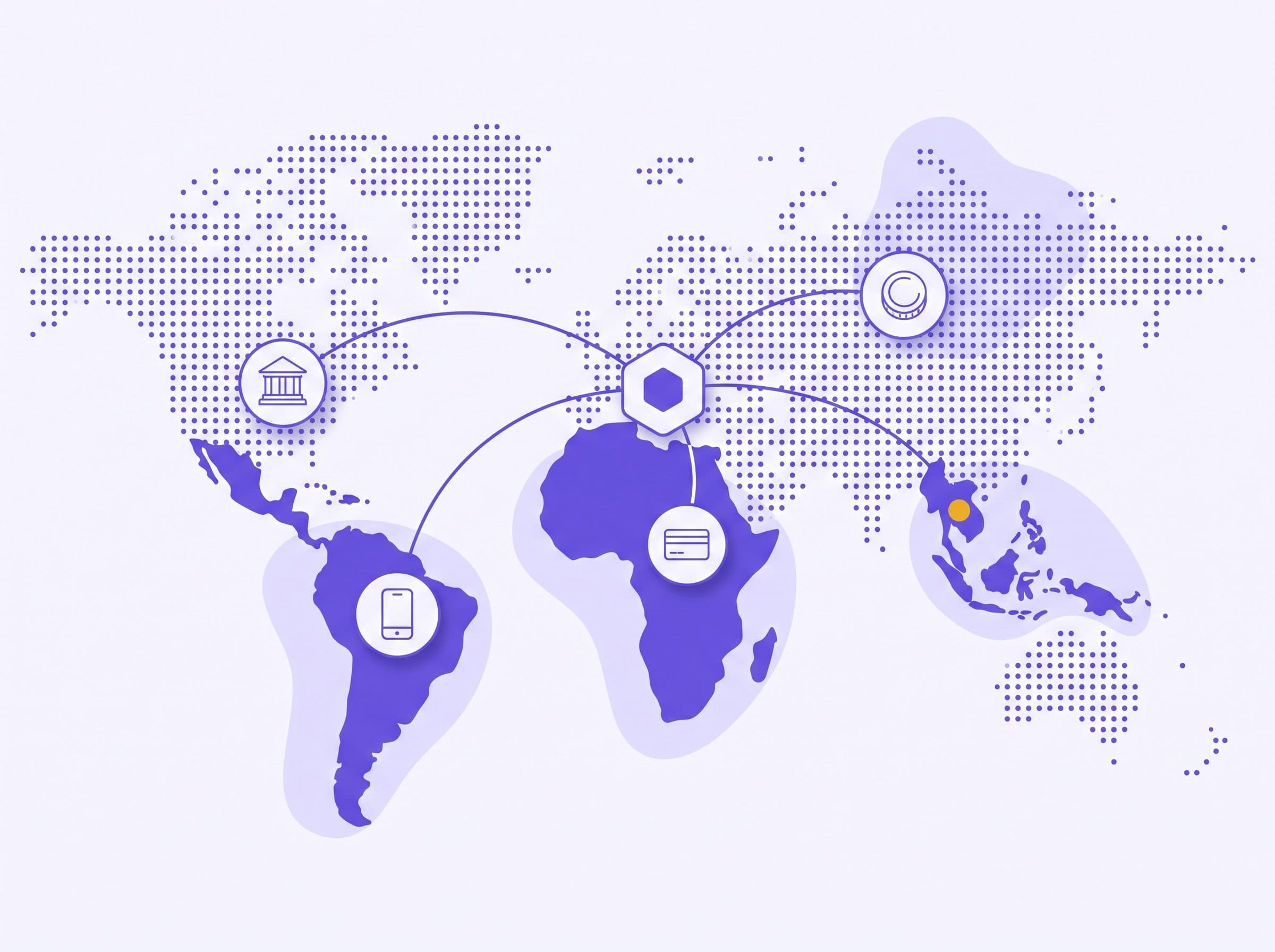
One integration reaches bank accounts, mobile money, cards and agent cash across Africa, LATAM and Asia. Most providers in Nigeria pay to one rail in one country. We pay across rails and regions from the same API.
| Method | Where | Currencies | Payout speed |
|---|---|---|---|
| Bank transfer | CBN-member banks (Nigeria) and global | NGN, USD, GBP, EUR | Same day or faster |
| Mobile money | M-Pesa, MTN MoMo, Airtel Money, Orange Money, Wave, Moov Money | KES, GHS and local | Real time |
| Card payout | Africa, LATAM, Asia | Multi-currency | Same day |
| Agent cash | Cash pickup and agent networks | Local | Real time |
Need to confirm a rail, country or currency? Check the live coverage in our acceptance index.
For developers
How to integrate the payout API
One payout API covers single and bulk disbursement. Teams shopping for a bulk payment API are looking for exactly this: send one payment or fifty thousand through the same endpoint, with webhooks for status and a sandbox to test before you go live.
Teams without engineers can skip the code. Upload a CSV in the dashboard and we run the batch the same way. The result is fewer manual transfers and fewer payout errors.
- REST API with a batch endpoint
- Webhooks for per-payment status
- Sandbox keys for testing
- CSV upload for non-technical teams
Settlement
Settlement: fiat or crypto
You choose how the payout leg settles. Fund and settle in fiat, in your local currency or USD, or settle in crypto using a stablecoin. No payout provider in Nigeria offers both on one platform.
This matters for cross-border payroll, marketplace sellers and treasury teams that hold crypto. You move funds the way that suits your business, then disburse to recipients in the rail they expect.
Crypto payouts
Mass payouts in crypto: which leg the crypto is actually on
A crypto mass payout has two legs, and only one of them is crypto. You fund and settle your payout balance in a stablecoin, which our OTC desk runs. The disbursement leg then lands on each recipient's local rail: a bank account, a mobile-money wallet or a card.
Searches for mass crypto payouts, crypto mass payments and batch payouts for crypto cover two different jobs, and most pages answer only one of them. The first job is treasury: you hold value in a stablecoin and you want to pay a payroll or a seller run out of it. The second is disbursement: you want the recipient to receive crypto. They have different answers, and conflating them is how a batch gets planned around the wrong rail.
Our answer to the first is the OTC desk. It converts and carries the crypto leg, so your funded balance can arrive as USDT or USDC and leave as the currency each recipient is actually paid in. That is settlement in fiat or crypto, and it is a desk product rather than a checkout option on the payout API.
Our answer to the second is the coverage table above. The disbursement leg runs on the rails a recipient already uses: a bank account, a mobile-money wallet, a card or an agent cash point. That is what makes a run land, and it is why a contractor in Kampala and a seller in Bogota can sit in the same batch that you funded in a stablecoin.
| Leg | What moves | Who runs it |
|---|---|---|
| Funding and settlement | Stablecoin in, or your local currency or USD, into the balance the batch executes against | Our OTC desk, as a separate product from the gateway |
| Disbursement | Bank transfer, mobile money, card payout or agent cash, in the recipient's own currency | The payout run on this page |
The crypto leg is the funding and settlement leg. Ask us what a specific corridor looks like end to end before you plan a batch around it.
Limits & throughput
Batch limits and throughput: what caps a payout run
No single number caps a bulk payout run. Four things do: the rail operator's own per-transaction and daily ceilings, the balance you have funded, how many recipient records pass validation, and the limits set on your account at onboarding. The first is fixed by the rail. The rest are yours to plan.
Most payout pages publish one headline batch size and stop. It reads well and it is close to useless, because a run that pays tens of thousands of recipients across six markets does not meet one ceiling. It meets a different ceiling on every rail it touches, and it meets them at different times of day.
That is the part worth planning for when the recipient list is large. A single file can be perfectly valid and still execute in several waves, because the mobile-money operator in one market caps a wallet credit that the bank rail in another does not. We validate the whole list first, flag the records that will not land, and tell you where the run will queue before any money moves.
The practical answer for a large recipient group is to size the run against rails rather than against a platform number: group by market, fund the value the group needs, and let the batch execute per rail. That is how the same list pays a payroll in Lagos, a seller cohort in Nairobi and a contractor set in Dubai without a failed file.
| What sets the ceiling | Where it comes from | What it means for your batch |
|---|---|---|
| Rail operator limits | The bank, mobile-money operator or card network on the receiving end | Per-transaction and daily caps differ by rail and by market, so one batch can meet several different ceilings |
| Funded balance | Your account with us | A run executes against funded value. Fund the whole batch, or split it and fund each part as it goes |
| Recipient validation | Your own list | Records with a bad account number, an unsupported rail or a mismatched name are flagged before disbursement, so the run is smaller than the file |
| Your approved limits | Set with you at onboarding | Approved volumes and run size follow your business, your rails and your history rather than a published platform figure |
We do not publish one platform-wide batch ceiling, because it would be wrong in most of the markets we pay into. Your limits are set with you at onboarding and reviewed as your volume grows.
Who it's for
Who uses mass payouts
If you pay many people on a schedule, mass payouts replace the manual work. We built ours for high-volume and high-risk businesses that other providers turn away.
Payroll and contractor payments
Vendor and supplier settlements
Marketplace and gig-platform seller payouts
Loan and microloan disbursements
Refunds, commissions and affiliate payouts
Forex, CFD and crypto businesses
High-volume e-commerce and platforms
Many aggregators off-board forex, crypto and other high-risk merchants. We are built to keep paying them at scale.
Nigeria rules
Bulk payouts and CBN rules in Nigeria
The Central Bank of Nigeria sets the rules for bulk payments. Its "Disaggregation of Bulk Payment" circular requires every end-to-end bulk payment or transfer to be processed on the platform of a licensed bank or payment service provider, with a detailed breakdown of the accounts that receive the funds.
This means only CBN-licensed banks and payment service providers can run bulk payment solutions in Nigeria. Boldrails operates as a licensed principal provider: we hold our own payment licences and disburse directly, rather than routing your payouts through a third-party aggregator.
Domestic Nigerian bulk payments clear through NIBSS rails, including NAPS, the multi-bank bulk-payment platform.
Sources
Comparison
How Boldrails compares
Reviewed by: the Boldrails payments team
Here is an honest look at how we compare with other payout providers used in Nigeria. Each has strengths. Monnify, for example, has a low flat rate for domestic bank transfers.
| Provider | Payout methods | Settlement | Crypto settlement | High-risk accepted | Public price |
|---|---|---|---|---|---|
| Boldrails | Bank, mobile money, cards, agent cash | Fiat or crypto | Yes (stablecoin) | Yes, by design | Volume-based (quote) |
| Monnify | Bank transfer, agent cash | NGN | No | Not stated | From ₦10 per transfer |
| Duplo | Bank, mobile money, cards | Multi-currency | No | Not stated | Quote-based |
| Onafriq | Mobile money, cards, bank, cash pickup | Multi-currency, 40 countries | Stablecoin (via partners) | NGO and aid focus | Quote-based |
| Flutterwave | Bank, mobile money | African corridors | No | Aggregator model | On request |
| Paystack | Bank transfer | NGN | No | Aggregator model | ₦10 to ₦50 per transfer (tiered) |
Competitor data from public sources, June 2026. Some pricing is available only on request.
Where we stand apart: multi-rail and multi-region payouts on one API, settlement in fiat or crypto as a first-party product, and acceptance for high-risk and high-volume merchants. We profile each provider from public sources, and some pricing is available only on request.
Vendor payouts
Vendor payouts, and how they differ from the batch that carries them
A vendor payout is a payment you owe a supplier, contractor or partner for work already delivered. It is the obligation. A mass payout is the mechanism that pays hundreds of them at once. You run vendor payouts through a bulk batch, which is why the two terms get used as if they were one thing.
The distinction matters when you pick a provider. Accounts payable tools are built for the approval side: they capture the invoice, route it for sign-off and mark it paid. They still hand the actual money movement to somebody else. We are that somebody else, and we are a licensed principal, so the payment leaves us and lands with your vendor on the rail they use.
That matters most where your vendors are. A supplier in Kampala takes MTN Mobile Money or Airtel Money. One in Nairobi takes M-Pesa. Sending both a SWIFT wire costs more than the invoice margin and takes days longer. We disburse to mobile money wallets, bank accounts and cards across Africa, Latin America and Asia in the same batch run.
| Term | What it names | Where it lives |
|---|---|---|
| Vendor payout | The obligation: one payment owed to one supplier, contractor or partner | This page |
| Mass payout | The mechanism: one batch run paying many recipients at once | This page |
| Marketplace seller payout | A seller's share of a buyer payment your platform split at capture | Marketplace payments |
If your vendors invoice you and you pay them, this page is the right one. If your platform collects from buyers and owes a cut to sellers, the split happens before the payout and belongs on our marketplace payments page.
FAQ
Mass payouts: frequently asked questions
Last updated: August 28, 2026